
THC microdosing has become one of the most talked-about ways to use cannabis. Wellness people are doing it. Productivity nerds are doing it. Your friend who used to be intimidated by edibles is now doing it. But what exactly is THC microdosing, and why has it gotten so f*@king popular?
In simple terms, microdosing THC means consuming very small amounts of tetrahydrocannabinol, the primary psychoactive compound in cannabis. Whether that's a gummy, a shot, or another low-dose format, the goal is to land in a window where you actually feel the functional effects (calmer, more focused, better sleep, lifted mood) without ever feeling overtly high. It's cannabis as a tool, not a takeover.
This guide is the pillar. We're going to cover what microdosing is, why it works, the dose ranges that matter, what the research actually says, and how MCRO built its entire product line around this approach. By the end, you'll know exactly what microdosing is and exactly how to start.

What Is THC Microdosing?
THC microdosing is the practice of taking small, sub-intoxicating doses of Delta-9 THC, typically between 1 and 5 milligrams per dose, to produce subtle, functional effects on mood, focus, sleep, stress, or appetite without the strong psychoactive experience associated with traditional cannabis use.
The distinction matters. A standard cannabis edible might contain 10 to 100 milligrams of THC per dose. A microdose lives in a totally different range, low enough that you remain fully in control of your day, but high enough that your endocannabinoid system actually registers the effect. The point isn't to feel less. The point is to feel different in a specific, useful way.
Microdosing has roots in psychedelic research (think low-dose LSD or psilocybin), but the application to THC has only really taken off in the last few years as low-dose hemp products have become widely available. The reason it works is the way THC interacts with your endocannabinoid system, which is the next thing we need to talk about.
How Does THC Microdosing Actually Work?
Your endocannabinoid system (ECS) is your body's master regulatory system for things like mood, sleep, appetite, stress response, immune function, and pain perception. According to a comprehensive review published in the Journal of Clinical Medicine, the ECS is a complex communication system involved in maintaining homeostasis across metabolism, immune response, pain modulation, and neuroprotection.
THC works by binding to two main receptor types in the ECS: CB1 and CB2. CB1 receptors are concentrated in the central nervous system and influence mood, memory, and cognition. CB2 receptors are mostly in immune cells and influence inflammation and immune response. Traditional cannabis doses flood these receptors and produce the strong psychoactive effects most people associate with being high. Microdoses produce gentle, modulated activation, which is what gives you the functional effects without the intoxication.
If you want to go deeper on the biology, our breakdown of the MCRO Method and why functional THC hits different walks through it in detail.
Why Do People Microdose THC?
Traditional cannabis consumption usually involves higher doses that produce noticeable psychoactive effects: euphoria, relaxation, sedation, sometimes anxiety or paranoia. Those effects might be exactly what someone wants for a Saturday night. They're often not what someone wants for a Tuesday afternoon. Microdosing exists to fill that gap.
Common reasons people microdose THC include:
Reducing Anxiety or Stress
Low-dose THC tends to behave very differently than high-dose THC when it comes to anxiety. Higher doses can trigger paranoia or worsen anxiety symptoms in sensitive individuals. Microdoses, by contrast, often produce a calming effect by gently modulating the CB1 receptor activity tied to mood. For more on this specifically, our piece on microdosing for anxiety: facts vs hype and our breakdown of whether THC helps with anxiety according to research cover the nuance.
Supporting Focus and Productivity
Many microdosers report improved concentration and a smoother flow state at low doses, particularly when THC is paired with cognitive-supporting ingredients like lion's mane. A pilot study published in Nutrients found that lion's mane extract improved working memory, complex attention, and reaction time in healthy adults within hours of ingestion. That's the foundation of why All Day and Let's Go pair THC with lion's mane specifically.
Easing Pain and Inflammation
A landmark randomized, double-blinded, placebo-controlled clinical trial published in the European Journal of Pain found that very low doses of THC (500 to 1,000 micrograms, delivered via inhaler) produced significant reductions in pain intensity compared to placebo in patients with chronic neuropathic pain, while avoiding the cognitive impairment associated with higher doses. The researchers concluded that low doses of cannabis may provide desirable effects while avoiding cognitive debilitations. Note: this study used an inhaler delivery system, not edibles, but it's important early evidence that the microdose range can be functionally active.
Improving Sleep
Low-dose THC tends to outperform higher doses for sleep quality, which is counterintuitive to most cannabis users. A small dose paired with melatonin and reishi (the formulation behind At Night) signals sleep gently rather than sledgehammering you into unconsciousness. For the deeper case on this, see why low-dose THC works better at night than high doses and microdosing THC for sleep.
Boosting Mood
Subtle doses can produce a noticeable lift in mood without intoxication. Many regular microdosers describe the effect as taking the edge off without losing any sharpness, which is the entire reason functional THC has become a category.

How Much THC Is a Microdose?
Most microdose strategies fall in the 1 to 5 milligram range of Delta-9 THC per dose. Some sources extend the upper range to 10 milligrams for users with higher tolerance, but the spirit of microdosing is taking less than what would produce overt impairment. If you can feel yourself getting high, you've moved out of the microdose range.
For context: a standard recreational cannabis edible commonly contains 10 to 100 milligrams of THC. MCRO Regular gummies are formulated at 2.5 to 5 milligrams per piece specifically because that range is where the functional sweet spot tends to land for most people. Our Extra Strength formulas at 10 milligrams per piece sit at the upper boundary of microdose territory and are designed for users with established tolerance.
Finding Your Personal Sweet Spot
Effective microdose is individual. Body weight, metabolism, tolerance, diet, sleep, and even stress level all influence how a given dose lands. The standard approach for finding your personal sweet spot is straightforward:
-
Start low. One Regular MCRO gummy (2.5 to 5 milligrams) is the standard starting point for first-time users.
-
Go slow. Wait the full 2 hours before considering any redose. According to peer-reviewed pharmacokinetic research published on ScienceDirect, oral THC effects peak roughly 1.5 to 3 hours post-ingestion.
-
Track what happens. Note mood, energy, focus, sleep quality, and any side effects in your phone. After a week you'll have a real dataset.
-
Stay consistent. Take your dose at the same time each day for the first few weeks. Your endocannabinoid system responds better to consistent input than random spikes.
For the full timing breakdown, our ultimate timing guide for THC gummies walks through every scenario.
Why Are Edibles the Most Popular Format for Microdosing?
Edibles dominate the microdosing space for three reasons: precision, discreetness, and duration. Each gummy contains an exact, lab-verified amount of THC, so you can repeat experiences reliably. They look like normal candy, so consuming them in public doesn't draw attention. And the effects of an edible last 4 to 8 hours, which is dramatically longer than inhaled methods. That makes edibles ideal for daily routine integration.
Edibles also have a much gentler effect curve than inhalation. Onset is slower (typically 30 to 45 minutes), but the peak is steadier and the comedown is smoother. For functional microdosing, where the goal is sustained, even effects across hours, this is exactly the curve you want.
How MCRO Gummies Are Formulated
Most THC gummies contain THC plus sugar. MCRO formulas pair Delta-9 THC with specific functional mushrooms or nootropic blends targeted at specific outcomes:
-
All Day: 2.5mg Delta-9 THC plus a 14-mushroom blend for balanced mood, clarity, and steady all-day support.
-
Let's Go: 5mg Delta-9 THC plus 400mg of Lion's Mane for focus, energy, and motivation.
-
Calm Down: 5mg Delta-9 THC plus 500mg of Reishi for stress relief and tension easing without sedation.
-
At Night: 5mg Delta-9 THC plus 2.5mg melatonin and 500mg of Reishi for sleep support.
-
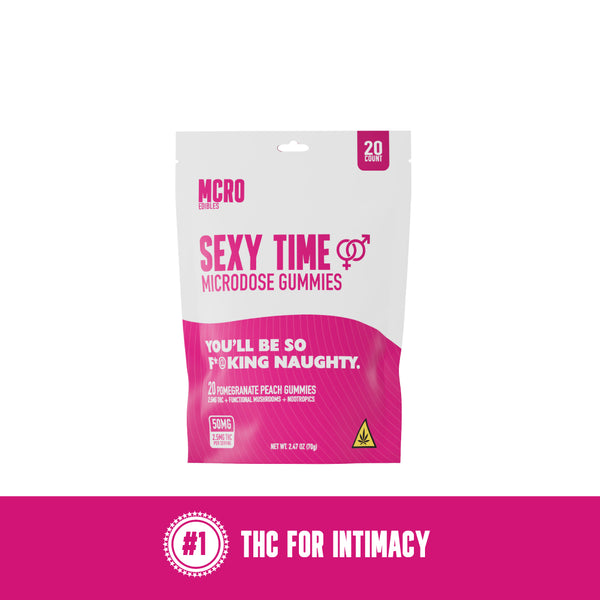
Sexy Time: 2.5mg Delta-9 THC plus a 2,000mg nootropic blend with Cordyceps, Tribulus, Red Ginseng, and Maca for mood, stamina, and intimacy.
A systematic review on the National Institutes of Health database found that lion's mane, reishi, and cordyceps mushrooms may have beneficial effects on cognitive function. For the deeper science on how these adaptogens interact with cannabinoids, see our breakdown of how medicinal mushrooms interact with THC.
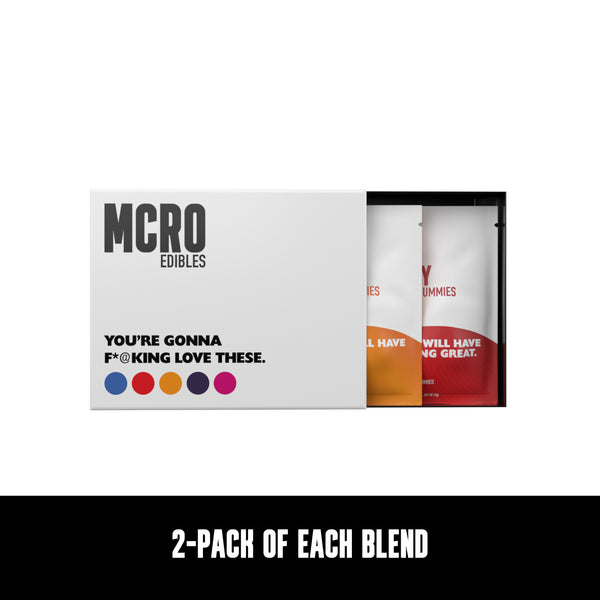
All MCRO Regular gummies are available in 20-count packs at $30. Extra Strength options are available at $45 for users with established tolerance. If you want to test multiple formulas before committing, the MCRO Sample Box includes two gummies from each line.
What About MCRO Shots?
Gummies are the foundation, but MCRO Shots offer a faster-onset alternative. Each 2-ounce shot delivers 5mg Delta-9 THC paired with functional ingredients (Lion's Mane and Cordyceps in Tropical Citrus for energy, Reishi in Mixed Berry for calm). Shots hit in roughly 10 to 15 minutes instead of the 30-plus minute window for gummies, with a shorter, more controlled effect curve. They're useful when you need precision timing.

What Should You Consider Before Starting to Microdose?
A few things matter beyond just the dose itself.
Onset and Duration
Edibles take 30 to 45 minutes to kick in and last 4 to 8 hours. Plan your dosing schedule around when you actually want the effects to land, not when you want to take the gummy.
Food Matters
THC is fat-soluble. A randomized crossover study published in Scientific Reports found that consuming cannabinoids with a high-fat meal significantly increases bioavailability compared to fasting. Taking a gummy with a small amount of fat (eggs, avocado, nut butter) produces a smoother, longer experience than empty-stomach dosing.
Tolerance Builds With Daily Use
Daily microdosers often incorporate one or two days off per week, or a full week off per month, to keep cannabinoid receptors sensitive. This isn't required, but it's a common move among experienced users.
Quality and Lab Testing
Buy from brands that publish certificates of analysis (COAs) showing exactly what's in each product. Cannabinoid dosing should be precise and verified by third-party labs. This is non-negotiable for repeatable experiences.
Individual Sensitivity
Some people are far more sensitive to THC than others. Half a gummy may be plenty. Listen to your body, not to whatever dose worked for your friend.
Is Microdosing THC Safe?
For most healthy adults, yes. Microdose-range Delta-9 THC (1 to 5 milligrams) sits well below the threshold for significant impairment, and consistent low-dose use tends to produce more predictable, less disruptive effects than occasional high doses. The European Journal of Pain trial cited above specifically found that low-dose THC produced functional benefits while avoiding the cognitive debilitations associated with higher doses.
That said, microdosing isn't for everyone. If you're pregnant, nursing, under 21, taking prescription medications, or managing a medical condition, talk to your doctor before starting. For more on safer practices, see our beginner's guide to safe microdosing practices.
How Do You Start Microdosing THC with MCRO?
The simplest path is straightforward. Pick one MCRO formula based on the outcome you want. Take one Regular-strength gummy. Wait the full 2 hours. Assess. Stick with that dose for a few days to lock in your baseline. Then start experimenting with timing, food pairings, and occasional product rotation once you understand how your body responds.
If you want to explore multiple formulas first, the MCRO Sample Box gives you two gummies from each line. If you already know what you want, the full MCRO collection has everything in stock.
Once you've nailed your baseline, the next reads are our MCRO Secret Menu for advanced stack codes and combinations, the advanced playbook for microdosing like a legend for temperature and timing protocols, and advanced MCROdosing for engineering your perfect state of mind for the deep-end protocols.

The Bottom Line
THC microdosing is a subtle but powerful way to integrate cannabis into a daily routine without the overwhelm that comes with traditional doses. Whether you're looking for relief from stress, better focus, easier sleep, or just a steadier mood across your week, microdosing offers a tailored approach that fits real life. Gummies in particular stand out for their precision, discreetness, and variety, and MCRO built its entire product line around making functional microdosing as reliable and predictable as possible.
The key to successful microdosing comes down to three things. Patience. Consistency. Mindfulness. A little truly does go a long way. Start with one gummy, wait the full window, and let your body tell you what works. The sweet spot isn't a race. It's a personal discovery.
Start your MCROdosing journey today and find your dose.
Frequently Asked Questions
What is THC microdosing in simple terms?
THC microdosing means taking very small amounts of THC, typically 1 to 5 milligrams per dose, to get the functional benefits of cannabis (better mood, sleep, focus, stress relief) without feeling overtly high. The point is to stay in control of your day while gently activating your endocannabinoid system.
How many milligrams of THC is a microdose?
Most microdoses fall between 1 and 5 milligrams of Delta-9 THC per dose, with some users extending up to 10 milligrams once tolerance is established. MCRO Regular gummies are formulated at 2.5 to 5 milligrams per piece specifically because that range is where the functional sweet spot lands for most people. Extra Strength formulas at 10 milligrams sit at the upper boundary of microdose territory.
Will I feel high from microdosing THC?
Most microdosers report feeling subtle effects (calmer, more focused, better mood, easier sleep) without the strong psychoactive sensations associated with traditional cannabis use. If you feel overtly high, you've likely moved out of the microdose range and into a standard dose. Lower the amount and reassess.
How long does it take to feel a THC microdose?
Most users feel first effects from a THC gummy within 30 to 45 minutes, with peak effects landing 1.5 to 3 hours post-ingestion. MCRO Shots, which are liquid, hit faster, typically within 10 to 15 minutes. Onset is faster on an empty stomach and slower with a full meal.
Can you microdose THC every day?
Many people do, and consistent daily microdosing tends to produce more reliable effects than occasional use as your endocannabinoid system adapts. That said, occasional tolerance breaks (one or two days off per week, or a week off per month) help keep cannabinoid receptors sensitive and your doses effective.
What's the best THC microdose for beginners?
Most beginners do best starting with one Regular-strength MCRO gummy (2.5 to 5 milligrams of Delta-9 THC) taken with a small amount of food. Wait the full 2 hours before deciding to take more. If you're particularly sensitive or new to cannabis entirely, start with half a gummy. The standard rule is start low, go slow.