
You know the drill. It's 1 AM, your brain won't shut the f*@k up, and you've already tried the deep breathing, the white noise app, and counting enough sheep to staff a New Zealand farm. You're not alone, roughly one in three adults deals with insomnia symptoms, and people are increasingly turning to THC gummies as an alternative to prescription sleep meds, melatonin bottles the size of your forearm, and whatever the hell "sleepy time tea" is supposed to do.
But here's what most people get wrong: they grab the strongest edible they can find, eat the whole thing, and either sleep like the dead (only to wake up feeling like they got hit by a bus) or end up even more wired than before. The secret to using THC for sleep isn't taking more. It's strategically taking less.
Welcome to your microdose guide.
Why THC Makes You Sleepy (When It Works)
THC interacts with your endocannabinoid system (ECS), a network of receptors throughout your brain and body that regulates a bunch of critical functions such as mood, appetite, pain, and yes, sleep. When THC binds to CB1 receptors in the brain, it can inhibit your arousal system, which is a fancy way of saying it tells the part of your brain that keeps you alert to calm the hell down.
But it goes deeper than just sedation. Research published in Neuropsychopharmacology found that low doses of THC can actually decrease sleep latency (the time it takes you to fall asleep) by increasing your body's natural melatonin production. That's right: THC doesn't just knock you out. At the right dose, it signals your brain to produce more of the hormone your body already uses to regulate sleep. It's working with your biology, not overriding it.
THC has also been shown to promote slow-wave sleep (SWS), which is the deep, restorative phase where your body does its actual recovery work like muscle repair, immune system maintenance, and memory consolidation. This is the sleep phase that makes you wake up feeling like a functional human instead of a sentient pile of laundry.
Here's the catch, though: higher doses of THC can suppress REM sleep, which is the phase responsible for dreaming and emotional processing. For people with PTSD or nightmare disorders, that's sometimes a benefit. But for most people, consistently skipping REM isn't ideal for long-term cognitive health. This is one of the biggest reasons microdosing makes more sense for sleep than going heavy, you get the deep sleep benefits without steamrolling the rest of your sleep architecture.

The Dose-Response Problem: More Isn't Better
This is the part where the research gets really clear, and it's the part most people ignore. THC's effect on sleep follows a biphasic pattern, meaning low doses and high doses do fundamentally different things.
At low doses (roughly 2.5-10mg for edibles), THC tends to promote relaxation, reduce the time it takes to fall asleep, and support deeper sleep stages. At higher doses, it can actually become stimulating for some people, increase anxiety, elevate heart rate, and lead to that groggy, hung-over feeling the next morning that defeats the entire purpose of trying to sleep better.
A University of Michigan study published in JAMA Pediatrics in late 2025 found that about 18% of young adults now use cannabis to help them fall asleep, making it more common than alcohol for that purpose. But researchers cautioned that relying on higher doses can backfire, disrupting sleep quality over time and potentially increasing tolerance, meaning you need more to get the same effect.
A 2025 meta-analysis in Sleep Medicine Reviews, which looked at over 1,000 participants across multiple studies, found that the sleep benefits from cannabis products were driven specifically by formulations containing THC and/or CBN (cannabinol). CBD-only products didn't significantly move the needle on sleep outcomes. The takeaway? THC is doing the heavy lifting when it comes to sleep, but the dose has to be right.
A randomized, double-blind, placebo-controlled crossover study published in the Journal of Sleep Research tested a medicinal cannabis oil on adults with clinical insomnia. The results were significant: midnight melatonin levels improved by 30% in the active group compared to a 20% decrease in the placebo group. Sleep quality improved significantly, and 60% of participants no longer classified as clinical insomniacs after the active phase. Notably, about 20% of participants reported full benefits on a lower dose range of just 4-6mg THC which is further evidence that you don't need a massive dose to get meaningful results.

How to Microdose THC for Sleep: A Practical Guide
Microdosing for sleep is different from microdosing for daytime use. The goal isn't subtle background support, it's deliberately nudging your body into sleep mode without overshooting into heavy sedation. Here's how to do it right.
Find Your Starting Dose
For most people, 2.5-5mg of THC is the sweet spot for sleep. If you're completely new to THC or have a low tolerance, start at 2.5mg. If you have some experience, 5mg is a solid starting point. The research consistently shows this range is effective for reducing sleep latency and promoting deeper sleep without the next-day grogginess.
Timing Matters More Than You Think
Edibles take time to metabolize typically 45-90 minutes before you feel the full effects, depending on your metabolism and whether you've eaten recently. This means if you want to be asleep by 11 PM, you should be taking your gummy around 9:30-10 PM. Don't wait until you're already in bed frustrated. By then, you're behind the curve.
Stick With It for at Least a Week
One night doesn't tell you much. Your endocannabinoid system responds to consistency. Give your dose and timing at least 5-7 nights before deciding if it's working. Keep a quick sleep journal, note when you took it, when you fell asleep, how many times you woke up, and how you felt the next morning. You're looking for patterns, not miracles on night one.
Adjust in Small Increments
If 2.5mg isn't cutting it after a week, bump to 5mg. If 5mg is giving you next-day fog, drop back down. The goal is the minimum effective dose, just enough to improve your sleep without creating a new problem. Jumping from 5mg to 20mg because "it didn't work fast enough" is how you end up in panic-attack-at-2-AM territory.
Take Tolerance Breaks
THC tolerance builds with daily use. If you're using a sleep gummy every single night, you may notice diminishing effects over time. Consider taking one or two nights off per week, or cycling one week on, a few days off. This keeps your CB1 receptors responsive and prevents you from needing to escalate your dose.

What to Look for in a THC Sleep Gummy
Not all THC gummies are created equal, and what you want for sleep is very different from what you'd want for a day at the beach. Here's what actually matters:
Precise, Low-Dose THC
You need a product that gives you exact, consistent dosing every single time. If the label says 5mg, it should be 5mg. Not "somewhere between 3 and 8mg depending on which gummy you grab." This is why edibles formulated specifically for microdosing are better for sleep than breaking a higher-dose gummy in half and guessing.
Complementary Ingredients
Melatonin is the most common addition to THC sleep formulas, and for good reason. Research shows that THC already supports natural melatonin production, and adding a small supplemental dose (typically 1-3mg) can reinforce your body's sleep signal. A Phase 1 pharmacokinetic study found that when THC and melatonin are co-administered, they may actually enhance each other's absorption, meaning the combination can be more effective than either ingredient alone.
Beyond melatonin, look for adaptogenic or calming ingredients. Functional mushrooms like reishi have centuries of use as sleep and relaxation aids, and modern research supports their role in regulating the HPA axis (your stress response system) and supporting GABA pathways. These ingredients don't replace THC's sleep-promoting effects, they complement them by addressing the stress and anxiety that often keep you awake in the first place.
Third-Party Lab Testing
This one's non-negotiable. You should be able to see a Certificate of Analysis (COA) confirming the product contains what it says it contains: accurate THC content, no heavy metals, no pesticides, no residual solvents. If a brand can't produce lab results, walk away.
How MCRO Approaches Sleep
If you've read this far and you're thinking cool, so where do I actually find this? This is where we come in. And no, we're not going to spend ten paragraphs selling you. Here's the deal:
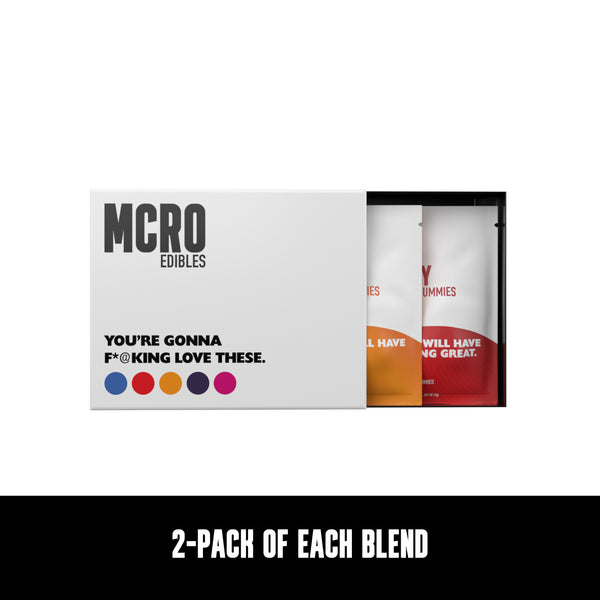
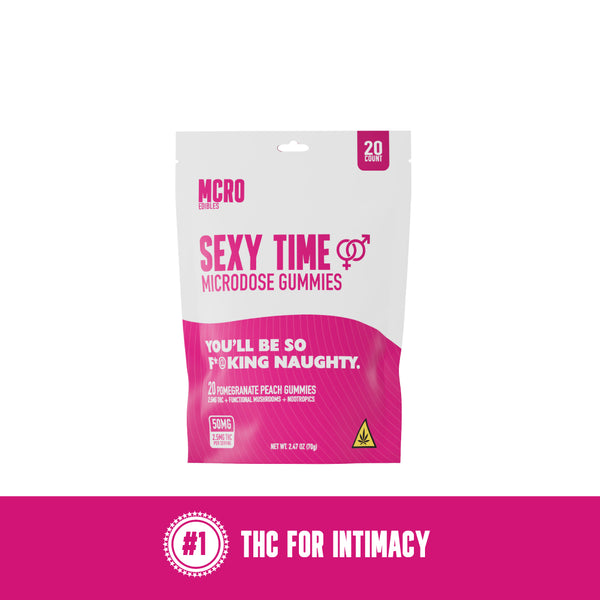
At Night is our sleep formula. It pairs 5mg Delta-9 THC with 2.5mg melatonin and 500mg of functional mushrooms per gummy or 10mg THC in the Extra Strength version for experienced dosers. The THC + melatonin combination is backed by the research we've covered here, and the functional mushroom addition supports the calming, stress-reducing side of the equation. Black raspberry flavor, because sleeping well should also taste good.
If your sleep issues are more about an overactive, anxious brain than a physical inability to fall asleep, Calm Down might be the move instead or a complement to your nighttime routine. It blends 5mg Delta-9 THC with 500mg of Reishi mushroom, which specifically targets stress response and relaxation without the melatonin component. Some MCROdosers use Calm Down in the evening to wind down, then follow with At Night when it's lights-out time.
Both are available in regular and Extra Strength. Start with the regular. Seriously. You can always go up.

THC vs. Other Sleep Aids: A Quick Reality Check
You've got options when it comes to sleep aids, and THC isn't the only player. Here's how it stacks up.
Melatonin alone can help with circadian rhythm issues (jet lag, shift work), but it doesn't address the anxiety, pain, or racing thoughts that keep most people awake. It's a timing signal, not a sedative.
Prescription sleep meds (like Ambien or Lunesta) are effective but come with well-documented side effects such as dependency risk, next-day impairment, sleepwalking, and that weird "did I eat an entire block of cheese at 3 AM?" phenomenon. They're also designed for short-term use, which doesn't help if your sleep issues are chronic.
CBD alone has anxiety-reducing properties that can indirectly support sleep, but the 2025 Sleep Medicine Reviews meta-analysis found that CBD-only products didn't significantly improve sleep outcomes on their own. CBD works better as a supporting ingredient alongside THC.
THC gummies at the right dose offer a middle path being effective enough to meaningfully improve sleep onset and depth, gentle enough (at microdoses) to avoid major side effects or dependency concerns, and stackable with complementary ingredients like melatonin, reishi, and CBN for a more complete approach.
Common Mistakes People Make With THC and Sleep
Let's save you some trial and error.
Taking too much. We said it before and we'll say it again. More THC does not equal better sleep. It often equals worse sleep, next-day fog, and a growing tolerance problem. Stay in the 2.5-10mg range for edibles.
Inconsistent timing. Taking a gummy at 9 PM one night, midnight the next, and 7 PM the night after isn't a sleep protocol, it's chaos. Your body thrives on routine. Pick a time, stick with it.
Using THC as the only intervention. THC gummies work best when paired with basic sleep hygiene, consistent bedtime, cool room, screens off, no caffeine after 2 PM. A gummy isn't going to overcome three espressos and doom-scrolling until midnight.
Eating a full meal right before your gummy. A heavy meal can delay absorption significantly, pushing your onset from 60 minutes to two hours or more. A light snack with some healthy fat is fine and can actually help absorption, but don't stack it on top of a five-course dinner.
Giving up after one night. The endocannabinoid system takes time to calibrate. One night at a new dose tells you almost nothing. Commit to at least a week before making adjustments.
Want to learn more? Read our Ultimate Timing Guide for Microdose THC Gummies: HERE
The Bottom Line
Sleep is not optional, it's not a luxury, and you shouldn't have to white-knuckle your way through another night of ceiling-staring. THC gummies, specifically low-dose, microdosed THC gummies, are one of the most promising natural sleep tools available right now, backed by a growing body of research showing they can reduce the time it takes to fall asleep, increase deep sleep, and support your body's natural melatonin production.
The key is precision: the right dose (start at 2.5-5mg), the right timing (60-90 minutes before bed), the right formula (THC + melatonin + calming support ingredients), and the right consistency (give it a week, keep a journal, adjust slowly). Get those variables dialed in, and you're not just sleeping better, you're waking up better. And that's the whole f*@king point.
This blog is for educational purposes only and is not intended as medical advice. If you're experiencing chronic insomnia or a sleep disorder, please consult a healthcare professional.